Ankle Sprain

Ankle sprains are one of the most common childhood injuries.

In these injuries, the ligaments become overstretched and it causes tears and bleeding. You will likely notice swelling and bruising around the ankle joint following these injuries. The bruising can take a few days to show up.

Exercises

Range of Movement Exercises

It is important to encourage your child to gently exercise and stretch the ankle. These exercises can be started from the day of your injury. Keeping your ankle moving will help speed up the healing process, avoiding stiffness and helping to reduce the swelling. 

Try to complete these exercises 5 times daily and you can ice your ankle after completing.

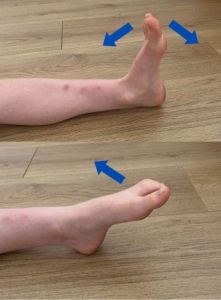
Point toes upwards and then point them down to the floor. / Pwyntiwch fysedd eich traed i fyny ac yna pwyntiwch nhw am y llawr · Ffurfiwch siâp y llythyren A gyda’ch troed
  • Point your toes up to the ceiling
  • Point your toes down to the floor
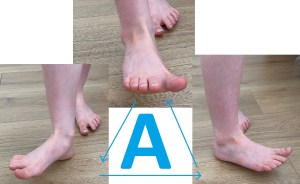
Tracing the letter A with foot / Ffurfiwch siâp y llythyren A gyda’ch troe
Tracing the letter B with foot / Ffurfiwch siâp y llythyren B gyda’ch troe
  • Trace the alphabet with your toes
  •  Turn your feet in so the soles of your feet face each other
  • Turn your feet out so the soles of your feet face away from each other

You may need someone to help you complete the exercises to start with, but over time they should become easier to complete independently.

Proprioception (balance) exercises

Try to complete the following exercises once your physiotherapist has advised it is appropriate to do so;

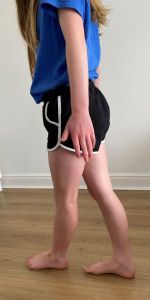
Weight transfers:
Stand in front of a mirror and try to make sure you are taking an equal amount of weight on your left and right leg. Use the mirror to see if you are leaning to one side. Once you are comfortable doing this, progress to shifting your weight from side to side. If you need to, hold on to a sturdy surface when doing this to keep your balance.

Walking with one foot in front of the other like on a tightrope / Cerddwch gydag un droed o flaen y llall fel petaech ar raff dyn

Tandem walking

  • Imagine you are walking on a tightrope.
  • Place the heel of one foot in front of the toes of your other foot.
  • Continue repeating this and walk forwards.
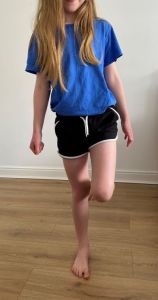
Single Leg stand / Ceisiwch sefyll ar y goes sydd wedi’i hanafu.

Single leg stand

  • Try standing on your injured leg.
  • Balance.
  • Try and keep your balance for 30 seconds.
  • Have a sturdy surface near by that you can use to steady yourself if you lose your balance.

Strengthening exercises

Once you can stand and fully weight bear on your injured ankle without increased pain and swelling you should be able to progress to strengthening exercises. Try these exercises below, however if they cause increase pain and swelling then rest a little longer and continue when you feel able.

Complete these exercises 10 times, once or twice a day for 2-4 weeks. You can use resistance bands or the opposite foot to add resistance to the exercises.

Standing tall with feet flat on ground / Sefwch yn dalsyth gyda’r traed yn wastad ar y llawr.
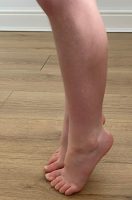
Pushing up on to toes and with heals off the ground / Codwch eich sodlau oddi ar y llawr nes eich bod yn sefyll ar flaenau eich traed.

Push up toes

  •  Stand tall and slowly push up onto your toes, raising your heels.
  • Hold for 3-5 seconds and slowly lower.
  • Repeat 10 times.

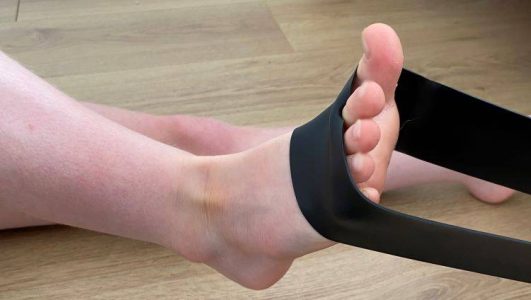
Lift against resistance

  • Loop foot within a latex resistance band or a tightly held rolled up towel
  • Lift your foot up against resistance.
  • Hold for 3-5 seconds and slowly lower back down.
  • Repeat 10 times.
Rhowch eich troed mewn band gwrthiant latecs neu dywel wedi’i rolio’n dynn.

Turn foot against resistance

  • Loop foot within a latex resistance band or a tightly held rolled up towel
  • Slowly turn your foot inwards against resistance. 
  • At the end of the movement hold for 3-5 seconds and then slowly return to the starting position.
  • Repeat 10 times.
Rhowch eich troed mewn band gwrthiant latecs neu dywel wedi’i rolio’n dynn.
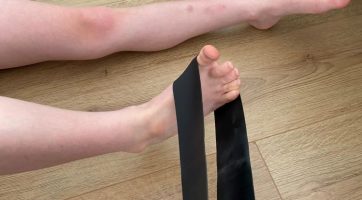
Using latex resistance band, turn foot outwards against resistance / Rhowch eich troed mewn band gwrthiant latecs neu dywel wedi’i rolio’n dynn a dal yn dynn gyda’r droed arall.

Turn foot against resistance

  • Loop foot within a latex resistance band or a tightly held rolled up towel and hold tight with the other foot.
  • Slowly turn your foot outwards against resistance. 
  • At the end of the movement hold for 3-5 seconds and then slowly return to the starting position.
  • Repeat 10 times.
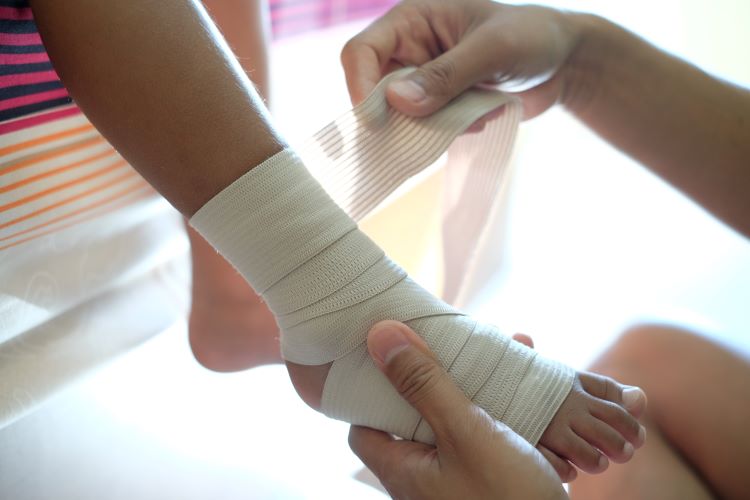
Ankle being bandaged / Rhwymo pigwrn

The ankle is made up of bones and strong ligaments that hold the bones together. The ligaments help give the ankle stability.

Ankle sprains often happen when you go over on your ankle, with a sudden movement or twisting action. 

For further advice and guidance call Dolphin Physiotherapy Outpatients on 029 218 47577

Noah’s Ark Children’s Hospital of Wales
Heath Park
Cardiff
CF14 4XW

Noah's Ark Children's Hospital for Wales, Ysbyty Plant Cymru

If you have any concerns or queries about your child’s recovery please contact Dolphin Outpatients on 02921 847577.


If you child does not have an appointment arranged with physio and symptoms continue or are not improving gradually, then you can self-refer your child to the Paediatric physiotherapy outpatient department by telephoning our referral line on 02921836908.

Keeping Me Well - Cardiff and Vale University Hospital

Help us improve Keeping Me Well!

We’re currently working to improve the Keeping Me Well website. If you’d like to help us make this site a better, more helpful experience for you, please take a few minutes to let us know what improvements you’d like to see.