







As an amputee, you are at risk of falling, both when wearing your prosthesis and when you are not. This booklet aims to advise you on how to prevent falls around the home, and how to manage if you do fall.
There may be other factors which put you more at risk of falling, for instance:
If you are concerned about any of the above, see your doctor. You can also ask your doctor to review your prescribed medication regularly. Try to have regular eyesight tests with an optician; eye tests are free if you are over 60.
First, carry out a top to toe check, and ask yourself:
Your physiotherapist will teach you this as part of your walking training.
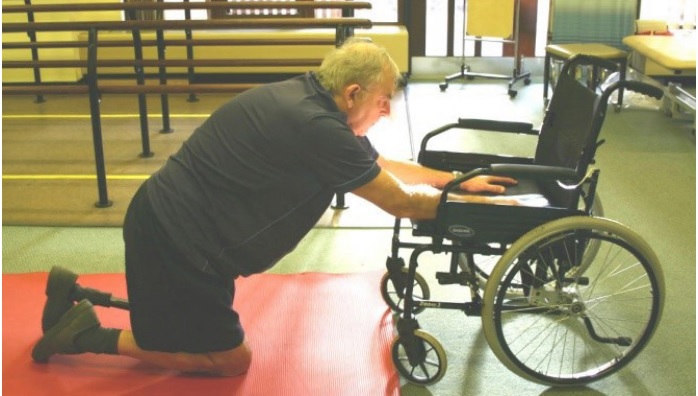
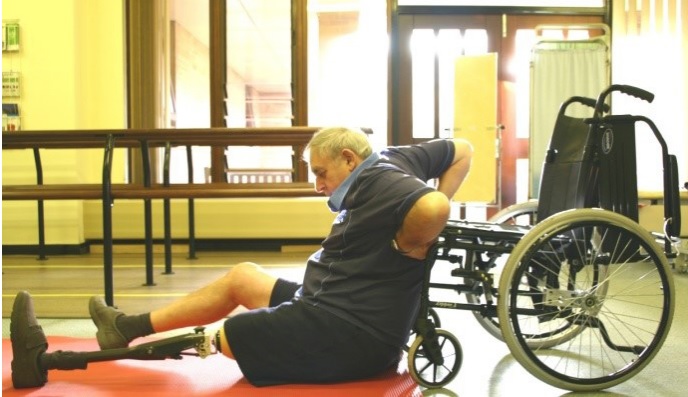
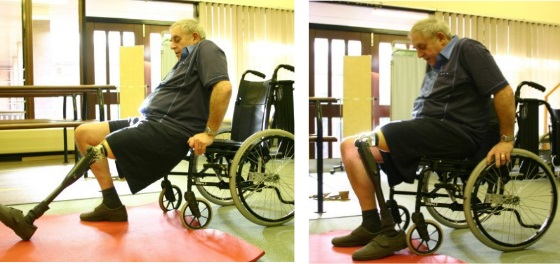
Here we describe two ways of getting up – on your hands and knees and by lifting yourself backwards, and you will have been taught the best way for you, depending on your level of amputation, and the strength in your arms.
Check that you are able to get up, that you have no pain and that you can move your arms and legs normally. Move yourself close to an item of furniture which you can use to help you up. This may be your wheelchair (ensure the brakes are on) or an armchair.
Roll onto your side. Push yourself onto one
hip and bend your knees.
Push yourself up onto your hands and knees into a crawling position. If your amputation was above the knee, you can still use this
method by kneeling through the prosthetic knee. If you need to roll over to get into this
position it is best to go towards your sound leg so as not to ‘trap’ your prosthetic leg
beneath you.
Hold onto your wheelchair or armchair.
Facing the chair lift your sound leg and place
the foot flat on the floor.
Push up through your arms and your leg
to lift yourself into a standing position.
Turn yourself to sit on the chair.
Check that you are able to get up, that you have no pain and that you can move your arms and legs normally. Move yourself close to an item of furniture which you can use to help you up. This may be your wheelchair (ensure the brakes are on) or an armchair.If you are using your wheelchair, take out the cushion, this will lower the height of the seat.
Taking off the arms of the wheelchair will also make holding the seat easier as you get up. Turn yourself so that your back is to the chair. You should sit about 5-6 inches in front of the chair.
Reach your hands behind you to hold the seat of the chair firmly. Bend your soundleg to firmly place your foot on the floor.
Push through your arms and your sound leg to lift yourself up onto the seat.
If the seat is too high, you may need to break the lift into two by using cushions from your settee. The method is then exactly the same.
Whichever way you use to get up from the floor make sure that you rest and check yourself over again before you try to move. Your prosthesis may have twisted or loosened during the fall, and you may need to take it off and re-adjust it. You will also be shaken and shocked from the fall, so take your time before you try to get up again. Always make sure that you tell somebody about your fall, and monitor yourself for any increase in pain or if you begin to feel unwell.
Always tell your GP or a health professional about your fall. If you have had 2 or more falls in the last 12 months and feel your ability to safely use your prosthesis has deteriorated, please inform a member of staff at the Centre. The team at the Centre can then assess you to help reduce the risk of you falling.
If you have any questions or concerns regarding the information above then please get in touch with the team at the Artificial Limb and Appliance Centre.
Artificial Limb and Appliance Centre (ALAC)
Rookwood Hospital
Fairwater Road
Llandaff
Cardiff
CF5 2YN
Reception / Appointments : 029 2031 3930
Physiotherapy Department: 029 2031 3921
Find out more on the Cardiff and Vale University Health Board website.

We’re currently working to improve the Keeping Me Well website. If you’d like to help us make this site a better, more helpful experience for you, please take a few minutes to let us know what improvements you’d like to see.